 Destinations / Tanzania / Serengeti National Park
Destinations / Tanzania / Serengeti National Park
Destinations / Tanzania / Serengeti National Park
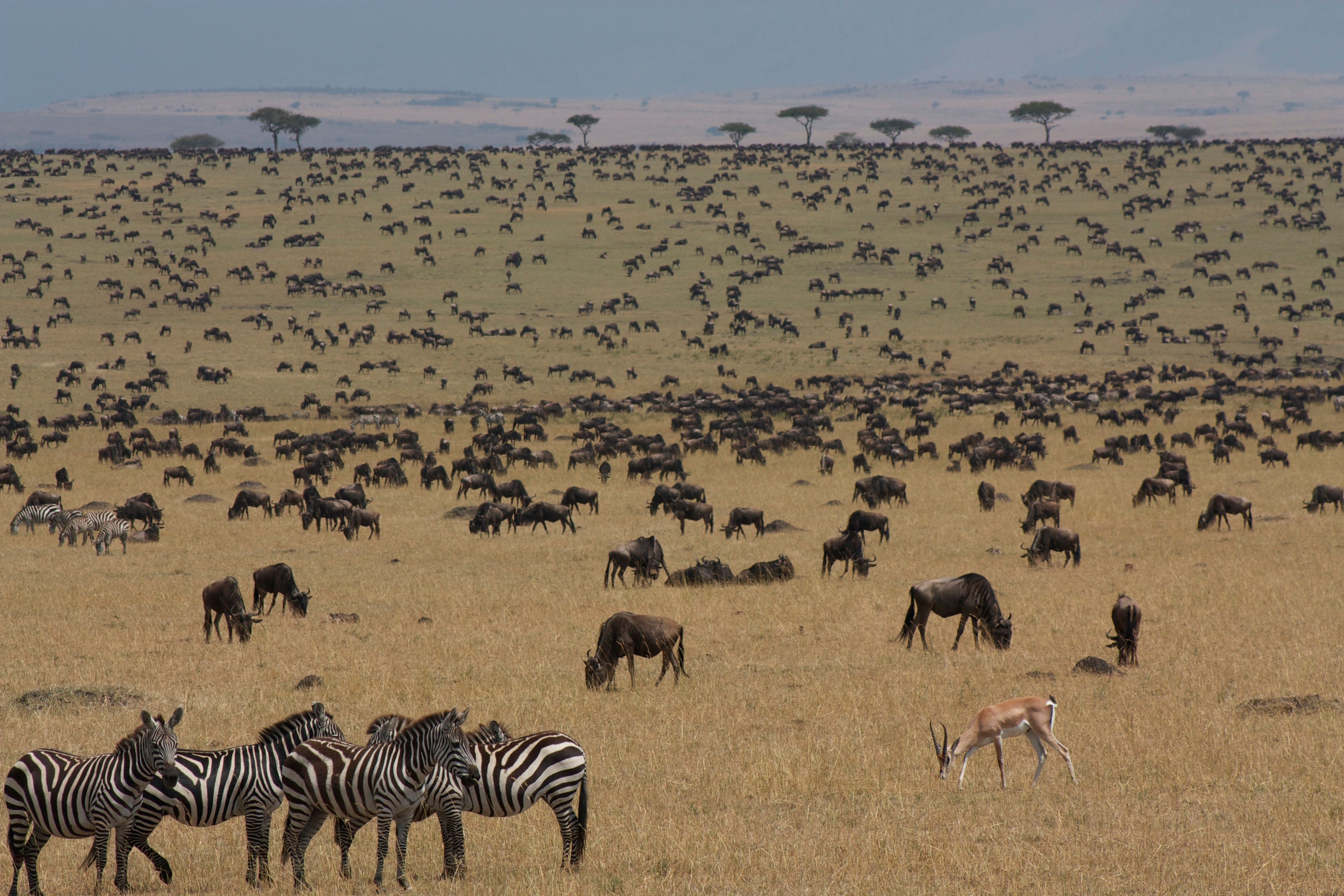
Nothing prepares you for the scale of it — wildebeest and zebra spread to the horizon in every direction, grazing their way across grassland that stretches further than the eye or the camera can hold.
The word "Serengeti" comes from the Maasai siringet, meaning "the place where the land runs on forever" — and standing at the edge of the plain during migration season, that's exactly what it feels like.
Peak Mara River crossings are underway
2026 forecasts point to the most dramatic crossings falling between August 10 and September 20, as the herds push north into Kenya's Maasai Mara — late August, right now, is one of the strongest windows of the year to witness one.
More than 1.5 million wildebeest, joined by hundreds of thousands of zebra and gazelle, follow an ancient clockwise circuit through the Serengeti-Mara ecosystem each year — chasing fresh grass and water rather than any fixed calendar.
Zebra and wildebeest often travel together — zebra crop the taller grass first, exposing the shorter growth wildebeest prefer, while gazelle trail behind for what's left. It's less a single migration than several species reading the same landscape in different ways.
Video via YouTube — "Serengeti National Park - Tanzania" channel
The migration's exact position shifts year to year with rainfall — a good guide or lodge will track the herd's current location, not a fixed calendar date.
Roughly July through September, herds cross crocodile-filled rivers into Kenya's Maasai Mara — the single most dramatic stretch of the migration.
Lion, cheetah, and hyena concentrate wherever the migration is thickest, making game viewing exceptional well beyond the grazing animals themselves.
Three ways to time a Serengeti trip around the migration itself.
The herd moves north-west through the central and western corridors, crossing the Grumeti River in smaller, more intimate groups than the Mara crossings later in the year.
The migration's most photographed stretch — herds crossing into the Maasai Mara, with the highest concentration of predators anywhere along the route.
Hundreds of thousands of calves are born within a few weeks on the short-grass southern plains — fewer crowds, and predator action close to the herd.
Standard safari practice across the plain — muted tones over bright colors or stark white.
Search options →At 14,750 km², most migration viewing happens at real distance, not up close.
Search options →Open plains offer essentially no shade during game drives.
Search options →As an Amazon Associate, UniverseTrips.com earns from qualifying purchases.
Genuinely found in exactly one place on Earth — the Merelani Hills near Mount Kilimanjaro, and nowhere else.
Where to find it — Licensed dealers in Arusha or Moshi — buy only from reputable sources given the stone's value
A real, distinctive East African carving tradition associated with Tanzania and Mozambique.
Where to find it — Craft markets in Arusha
Grown in the Kilimanjaro region — a genuine, legitimate coffee origin.
Where to find it — Shops in Arusha or Moshi
We're building out full migration-timing guides, park zone breakdowns, and lodge recommendations for the Serengeti-Mara ecosystem.
Back to top attractions