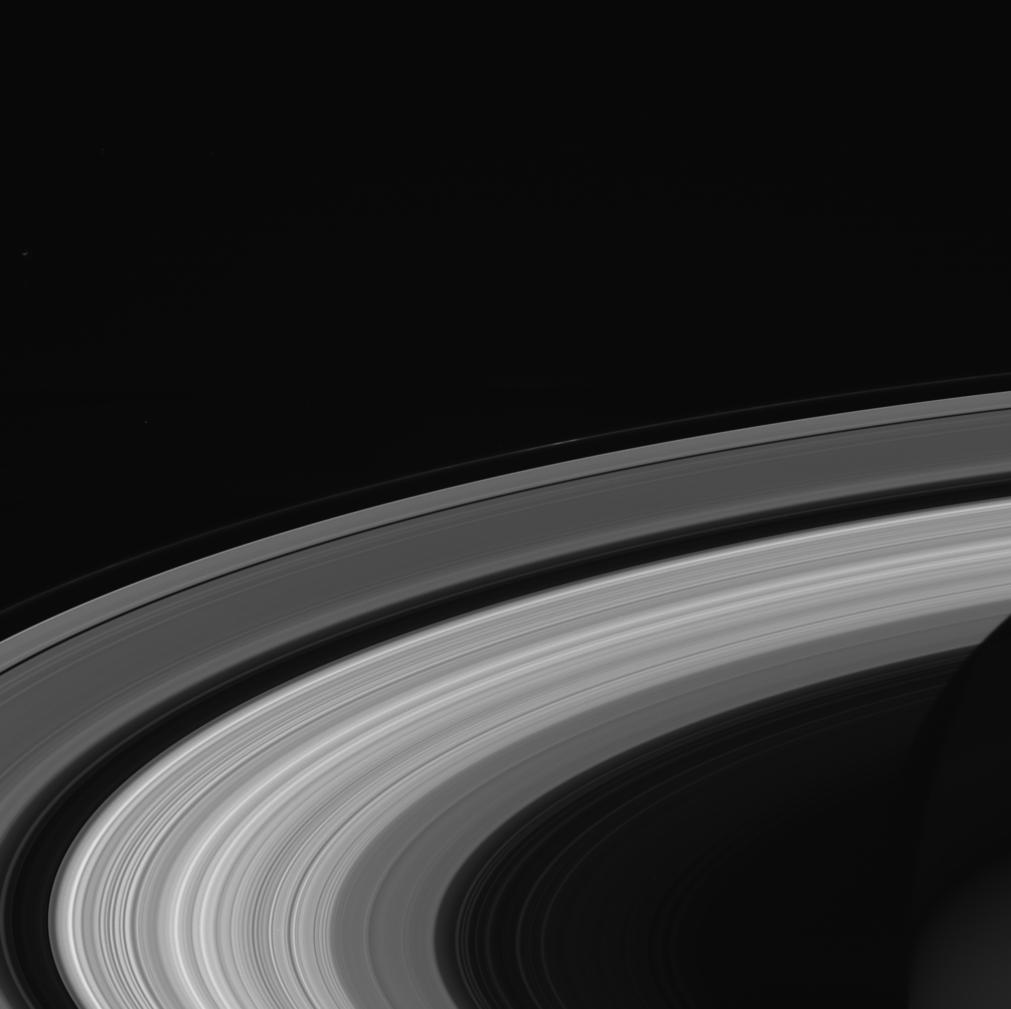
Real photograph: Saturn's rings, among the final images from NASA's Cassini spacecraft before its 2017 mission-ending plunge. Credit: NASA/JPL-Caltech/Space Science Institute.
A ring system scientists still can't agree is young or ancient
Saturn's rings are almost pure water ice — 95 to 98% by volume — and one of the most-studied structures in the solar system. And yet planetary scientists genuinely disagree about their age: some analyses put the rings at 10-100 million years old, younger than Earth's dinosaurs; a 2026 study argues they could be far older, close to Saturn itself. This is an imagined tour built around a real spacecraft's real flight path — and a debate nobody has settled.
Real photograph: Saturn's rings, among the final images from NASA's Cassini spacecraft before its 2017 mission-ending plunge. Credit: NASA/JPL-Caltech/Space Science Institute.
This tour's flight path isn't invented — it echoes something a real spacecraft actually did.
Saturn's rings are made almost entirely of water ice particles, ranging from dust grains to boulders — with just a trace of darker, non-ice material mixed in.
Cassini's gravity data pointed to rings just 10-100 million years old. A 2026 study in Icarus argues that "exposure age" may not equal true age at all — the rings could be billions of years older than that.
In 2017, Cassini made 22 real orbits threading the narrow gap between Saturn's rings and cloud tops, just 1,600-4,000km above the planet — before deliberately diving in to end its mission.
Below is the imagined tour itself — the part that's fiction. A concept for what hopping through Saturn's rings might actually feel like, moment to moment.
The station threads into the Cassini Division, a genuine 4,800km gap between Saturn's A and B rings, ice fragments drifting past the viewport at every scale from dust to houses.
Short, careful jumps carry the station from one stable ring gap to the next, each ice fragment catching sunlight differently — some ancient and grey with dust, others startlingly bright and clean.
The final approach threads the same narrow gap Cassini flew in 2017 — rings arcing overhead, Saturn's banded clouds filling the view below, close enough to make out storm structure by eye.
Pulling back out through the rings, a guide notes the unresolved debate: are you looking at something younger than Earth's continents, or something nearly as old as the solar system itself? Nobody currently knows for certain.
This is written as a concept, not a promise. No spacecraft has ever carried humans anywhere near Saturn, let alone into its rings — Cassini's own 2017 dive was uncrewed and deliberately mission-ending. Written here first, in case it's ever worth pitching further.