UniverseTrips.com Destinations / Japan
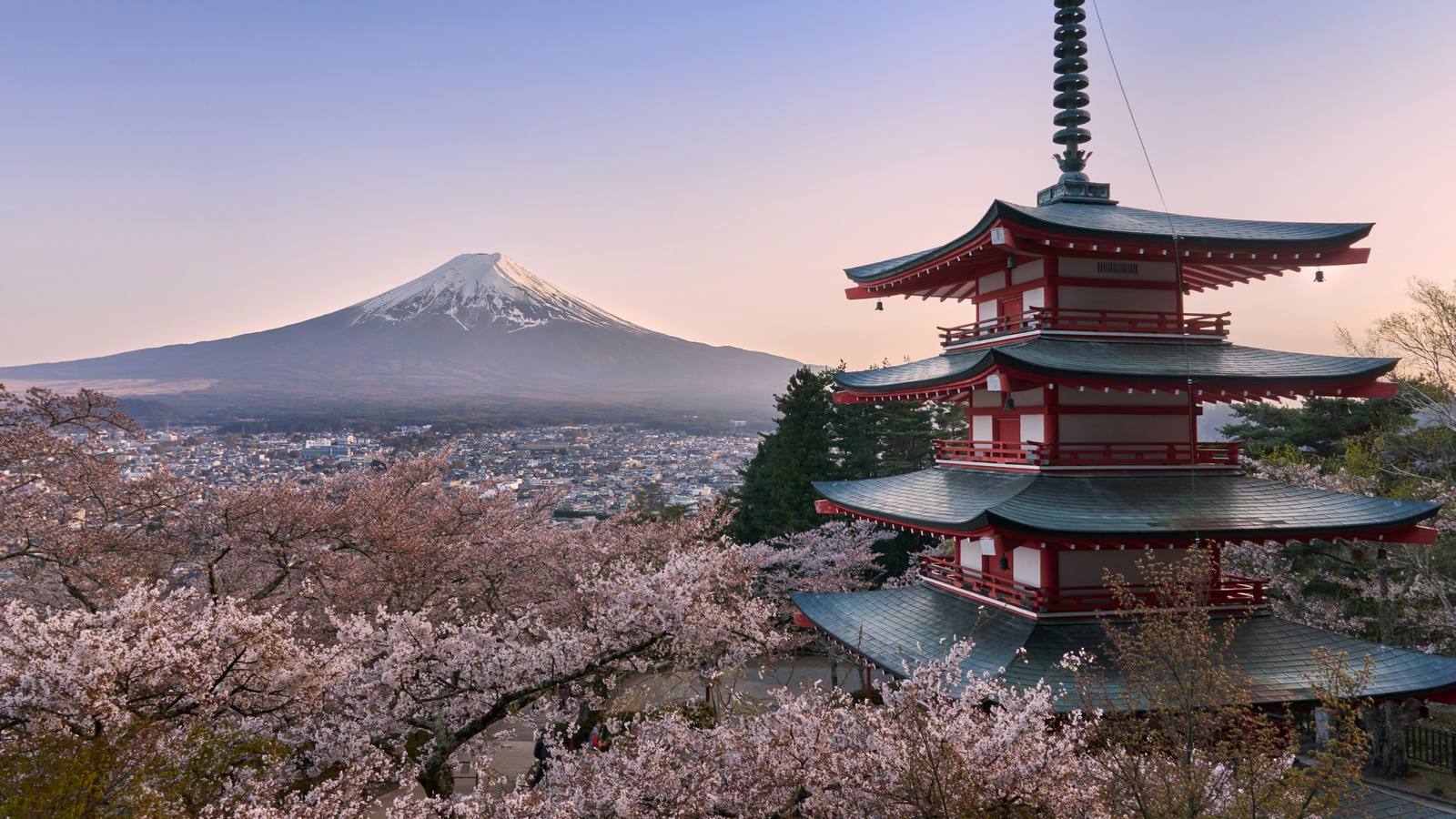
The five-storey Chureito Pagoda above Fujiyoshida with Mount Fuji behind it and cherry blossoms in the foreground, Japan
Japan — Country guide

Japan, where old and new share one train line

Tokyo's neon, Kyoto's temples, Mount Fuji and Hiroshima's island shrine, linked by some of the fastest and most punctual trains in the world.

Japan welcomed a record 42 million visitors in 2025, and 2026 has brought a wave of new costs to match: a higher departure tax, dearer rail passes, higher visa fees and steeper hotel taxes in Kyoto. Here is what has changed, and where to go.

The essentials, updated for 2026

Visa
Not needed by 74 countriesCitizens of 74 countries and regions can visit for short stays without a visa. Others now pay ¥15,000 for a single-entry tourist visa (raised from ¥3,000 in July 2026).
Departure tax
¥3,000Per person on flights and cruises booked from 1 July 2026, up from ¥1,000. It is built into the ticket price.
Japan Rail Pass, from 1 October 2026
¥53,000 for 7 daysOrdinary class; ¥84,000 for 14 days and ¥105,000 for 21 days. Buy a pass ↗ Partner link
Kyoto lodging tax, from 1 March 2026
¥200 to ¥10,000Per person per night, depending on the room rate. Most mid-range rooms (¥6,000 to ¥19,999) pay ¥400.
Climbing Mount Fuji
¥4,000 per climberOn the Yoshida Trail, open 1 July to 10 September, with a cap of 4,000 climbers a day and required gear checks.
Miyajima
¥100 visitor taxCharged since October 2023 to visitors to the island of Itsukushima Shrine.

Sources: Business Today, July 2026 (departure tax, visa fees, visitor numbers), JNTO (rail pass), Time Out (Kyoto tax), Official Mt. Fuji Climbing site and Get Hiroshima, checked 9 October 2026. Confirm before you pay.

Where to go

The capital

Tokyo

Most trips start here, through Narita or Haneda airport. Tokyo moves from the neon crossings of Shibuya and Shinjuku to the old temple streets of Asakusa, with world-class food at every price, from convenience stores to counter sushi.

Good base for day trips to Mount Fuji, Nikko and Kamakura

Book: teamLab Planets tickets ↗ Partner link

Temples and gardens

Kyoto

Japan's old imperial capital: the torii tunnels of Fushimi Inari, the bamboo groves of Arashiyama and quiet walks through the forested hills around the city. Since March 2026 Kyoto charges one of Japan's highest lodging taxes.

Lodging tax ¥200 to ¥10,000 per person per night, by room rate

Stay: Seryo, a ryokan in the Ohara hills ↗ Partner link

Food and deer

Osaka and Nara

Osaka is Japan's street-food city, at its loudest around the canal-side lights of Dotonbori. Nara, a short train ride away, is home to the giant bronze Buddha of Todai-ji and the free-roaming deer of Nara Park.

Easy to combine with Kyoto on one rail route

The sacred mountain

Mount Fuji and the Five Lakes

Japan's highest peak is best seen from the lakes at its northern foot, or from the Chureito Pagoda above Fujiyoshida. Climbers on the Yoshida Trail now pay a fee and must carry proper gear.

Yoshida Trail: 1 July to 10 September, ¥4,000 per climber, 4,000 a day

Book: Mount Fuji day trip from Tokyo ↗ Partner link

History and the sea

Hiroshima and Miyajima

Hiroshima's Peace Memorial Park and museum tell the story of 6 August 1945. A short ferry away, the island of Miyajima holds Itsukushima Shrine and its great torii gate standing in the sea at high tide.

Miyajima visitor tax ¥100 per person, collected with the ferry fare

Snow and summer flowers

Hokkaido

Japan's northern island: deep powder snow for skiing in winter, the Sapporo Snow Festival each February, and cooler summers with flower fields around Furano. It also largely escapes the early-summer rainy season.

Reach it by plane from Tokyo or by the Hokkaido Shinkansen

Japan National Tourism Organization ↗

When to go

Japan stretches from snowy Hokkaido to subtropical Okinawa, so the best time depends on where you are going and what you want to see.

Spring and autumn

  • Cherry blossoms usually peak in Tokyo and Kyoto in late March and early April: the most popular, and most crowded, time of year.
  • Autumn leaves colour the mountains from October and reach Kyoto's temples around late November.
  • Book hotels and rail seats well ahead for both seasons.

Summer and winter

  • June to mid-July is the rainy season across most of the country; Hokkaido largely escapes it.
  • Summer is hot and humid in the cities, but it is the only time to climb Mount Fuji.
  • Winter brings powder snow to Hokkaido, the Sapporo Snow Festival in February and the clearest views of Mount Fuji.

What to pack

Japan rewards light, practical packing: you will walk a lot, take your shoes off often and carry more cash than you might expect.

Comfortable walking shoes

Japan is a walking country: expect long days on foot between stations, temples and markets.

Search options

Easy slip-on shoes

You will take your shoes off often, at temples, traditional inns and some restaurants.

Search options

A coin purse

Cash is still common at shrines, small restaurants and markets, and ¥100 and ¥500 coins add up fast.

Search options

A power bank

Maps, translation and rail apps drain a phone quickly on long sightseeing days.

Search options

A compact umbrella

For spring showers and the early-summer rainy season.

Search options

Light layers

Temperatures swing between morning and evening, and between Tokyo, the mountains and Hokkaido.

Search options

A plug adapter

Japan uses two-pin Type A sockets at 100 volts; check your chargers can handle it.

Search options

A small hand towel

Many public washrooms have no paper towels or dryers, so locals carry a small cloth.

Search options

As an Amazon Associate, UniverseTrips.com earns from qualifying purchases.

Book this trip

Links to trusted booking partners

Exploring more of Asia?

Browse our destination guides, from Kyoto's hills and Bali's highlands to the Great Wall and the Taj Mahal.

All destinations