 Destinations / India / Amber Fort
Destinations / India / Amber Fort
Destinations / India / Amber Fort
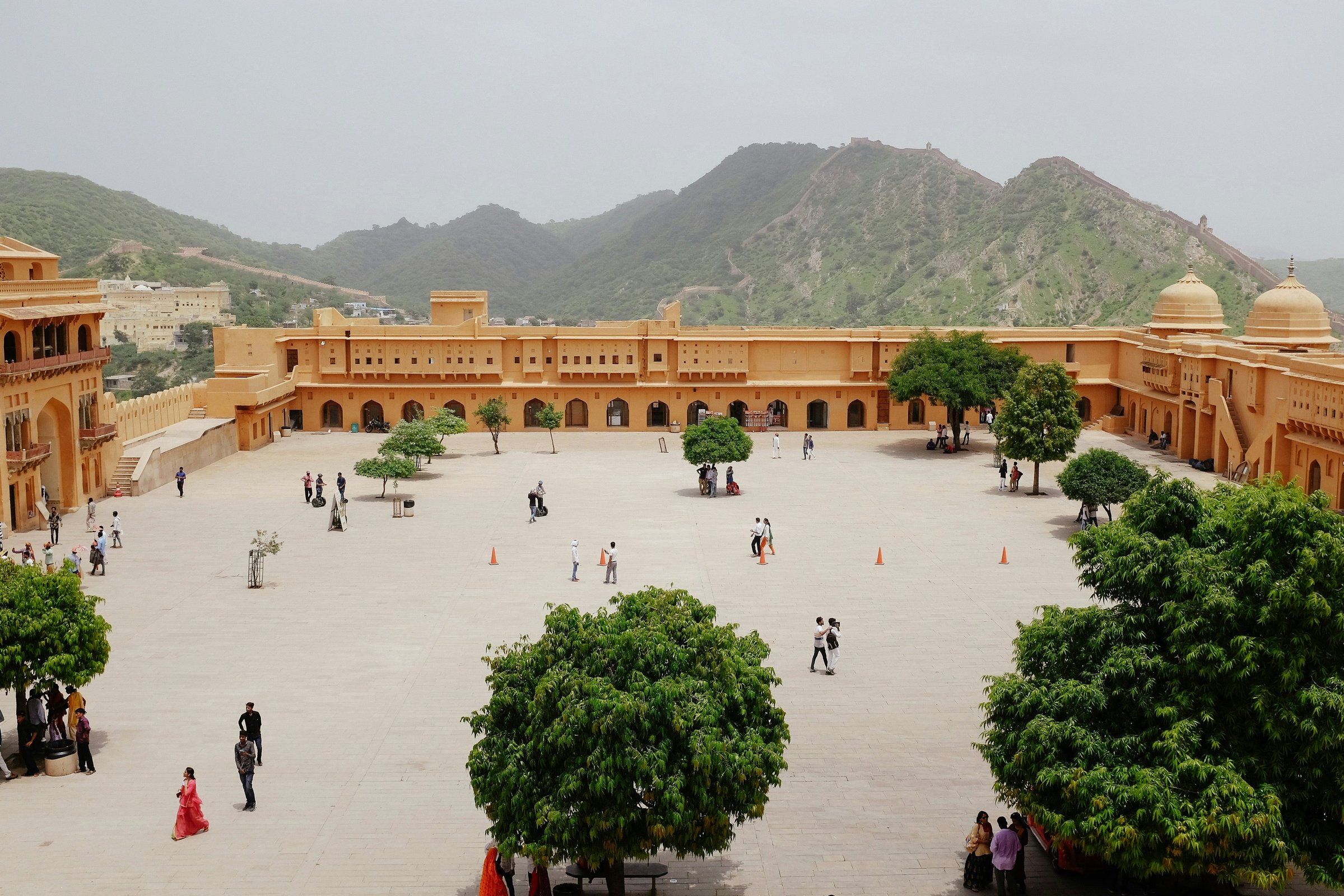
Amber Fort isn't one building on a hill — it's a defense system, with walls tracing the ridgelines around it like a smaller Great Wall, built by Rajput rulers to make the approach itself the first line of defense.
Construction began in 1592 under Raja Man Singh I and continued for generations — the fort blends Rajput military architecture with Mughal decorative style, a fusion that shows up throughout its courtyards and palace halls.
Entry fees revised as of January 1, 2026
Rajasthan's government updated monument pricing this year — Amber Fort entry now runs ₹100 for Indian visitors and ₹500 for foreign tourists. The Jaipur Composite Ticket (~₹600 Indian / ~₹1,500 foreign) covers Amber Fort plus Hawa Mahal, Jantar Mantar, and other city monuments over two days — worth it if you're seeing multiple sites.
Defensive walls extend well beyond the fort itself, climbing the surrounding ridgelines in a pattern that echoes China's Great Wall — visible in the background of nearly every wide shot of the courtyard.
Beyond the amber-colored sandstone exterior, the Sheesh Mahal (Mirror Palace) inside is inlaid with thousands of small mirrors and colored glass — designed so a single candle could illuminate an entire hall.
Video via YouTube — Rajasthan Tourism, the state government's official channel
The amber-toned stone photographs best in soft early light, before the midday sun flattens the courtyard's warm color.
Elephant rides up to the fort are offered but widely criticized on animal-welfare grounds — jeep transport is the better alternative.
A connecting passage links Amber Fort to Jaigarh Fort above it, home to one of the world's largest cannons on wheels.
Three ways to plan a visit around the light and the crowds.
Arrive close to opening for softer light on the sandstone and noticeably thinner crowds in the main courtyard.
The connecting passage to Jaigarh Fort makes a natural extension to the same visit, with sweeping views over Jaipur.
Jaipur's airport sits roughly 40 minutes from Amber Fort by taxi, often combined with other Pink City sights the same day.
Even in the Oct–Mar cool season, Rajasthan stays genuinely hot by midday — breathable fabric matters across the fort's open courtyards.
Search options →The defense system extends well beyond the main fort — expect uneven stone stairs and long stretches of walking.
Search options →Little shade across the fort's four courtyards, especially by midday.
Search options →Dry heat and extended walking — worth refilling rather than relying on vendors inside.
Search options →Useful if you're doing the full Jaipur Composite Ticket circuit — Amber Fort plus Hawa Mahal and Jantar Mantar in the same day or two.
Search options →As an Amazon Associate, UniverseTrips.com earns from qualifying purchases.
A genuine, GI-protected Jaipur craft — made from quartz rather than clay, glazed in a distinctive cobalt blue.
Where to find it — Workshops in Jaipur's old city, not generic tourist stalls
Rajasthan's hand block-printing tradition produces genuinely handmade fabric.
Where to find it — Sanganer and Bagru, the two towns near Jaipur where the tradition is centered
Jaipur is a real, major global hub for gemstone cutting and trading.
Where to find it — Established gem dealers in Jaipur's Johari Bazaar
A living regional art tradition, distinct from mass-produced prints.
Where to find it — Art shops and studios around Jaipur's old city
We're building out full courtyard-by-courtyard guides, Jaigarh Fort logistics, and Pink City pairing recommendations.
Back to top attractions