 Destinations / Chile / Torres del Paine
Destinations / Chile / Torres del Paine
Destinations / Chile / Torres del Paine
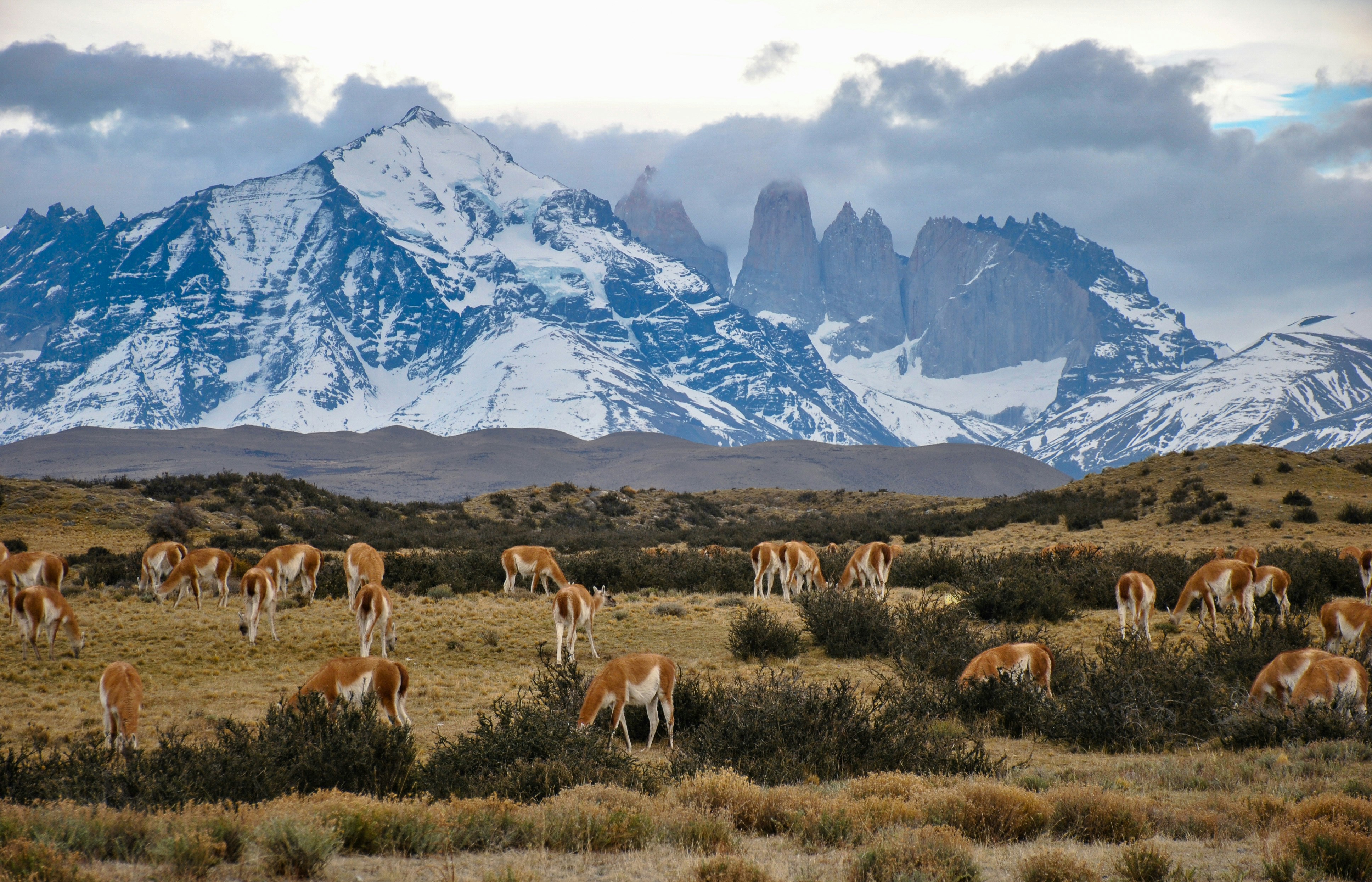
Three sheer granite spires rise straight out of Patagonian steppe, glaciers still clinging to the peaks beside them — and on the grassland below, wild guanaco herds graze exactly as they have for millennia.
Nothing about the towers is gradual — the pampas runs flat for miles, then three granite fingers punch straight up through the clouds, with no foothills to soften the transition.
The three namesake towers are a single granite intrusion, exposed and sculpted by Patagonian glaciers over millions of years — the surrounding peaks are older, softer sedimentary rock the ice wore away faster.
Wild guanaco herds move across the steppe in loose family groups, mostly undisturbed by the road traffic and hikers passing through — this park is one of the best places in South America to see them at this density.
Video via YouTube — Chile Travel, Chile's official tourism channel
A rebuilt trail to the Base Torres Viewpoint
The first phase of a major trail regeneration project has been completed at the Base Torres Viewpoint — one of the park's most heavily-trafficked and vulnerable routes — adding 3.3km of rebuilt trail (1.5km for hikers, 1.8km separated for horseback operations) to improve safety and protect the surrounding environment.
The classic day hike straight up to the foot of the three granite towers — steep, unforgettable, crowded by mid-morning.
A river of blue ice calving into Lago Grey — reachable by trail or by boat for a closer look at the face.
A hanging valley between the two massifs, with avalanches audible off the surrounding walls most afternoons.
Three ways to experience the park, from a single day to a full circuit.
A long day out to the main viewpoints and a short trail — doable without camping gear, weather permitting.
The classic multi-day route linking the Towers, French Valley, and Grey Glacier via refugios or campsites.
The full loop around the massif for those who want the backcountry side most visitors never see.
Patagonian wind is famously severe — a water-resistant jacket alone isn't enough here, you need real windproofing.
Search options →The Base Torres hike alone is a full steep day on granite and glacial terrain — don't break in new boots here.
Search options →Real stabilizers against Patagonian wind gusts, not just a hiking accessory — useful on steep, exposed sections.
Search options →Even in the Nov–March summer window, the towers rise to 2,850m — it stays genuinely cold up there.
Search options →Doubles as wind protection and sun cover on exposed steppe with no foothills to break the wind.
Search options →Glacier glare off Grey Glacier and the towers themselves is intense — standard sunglasses aren't always enough.
Search options →As an Amazon Associate, UniverseTrips.com earns from qualifying purchases.
Ponchos, scarves, and sweaters from Patagonian sheep estancias — a real regional industry, not imported filler.
Where to find it — Wool shops in Puerto Natales, not just tourist stalls
A native Patagonian berry with a real local legend: eat one, and you're destined to return to Patagonia.
Where to find it — Shops and markets throughout Puerto Natales
Chile is one of only two countries in the world that produces lapis lazuli, alongside Afghanistan.
Where to find it — More associated with Santiago than Patagonia — worth knowing if your trip includes both
Genuine regional wood and textile work, not mass-produced imports.
Where to find it — Puerto Natales' town markets
We're building out full W Trek itineraries, refugio bookings, and wildlife-viewing guides for this stretch of Chile.
Back to top attractions