UniverseTrips.com Destinations / Uganda / Murchison Falls
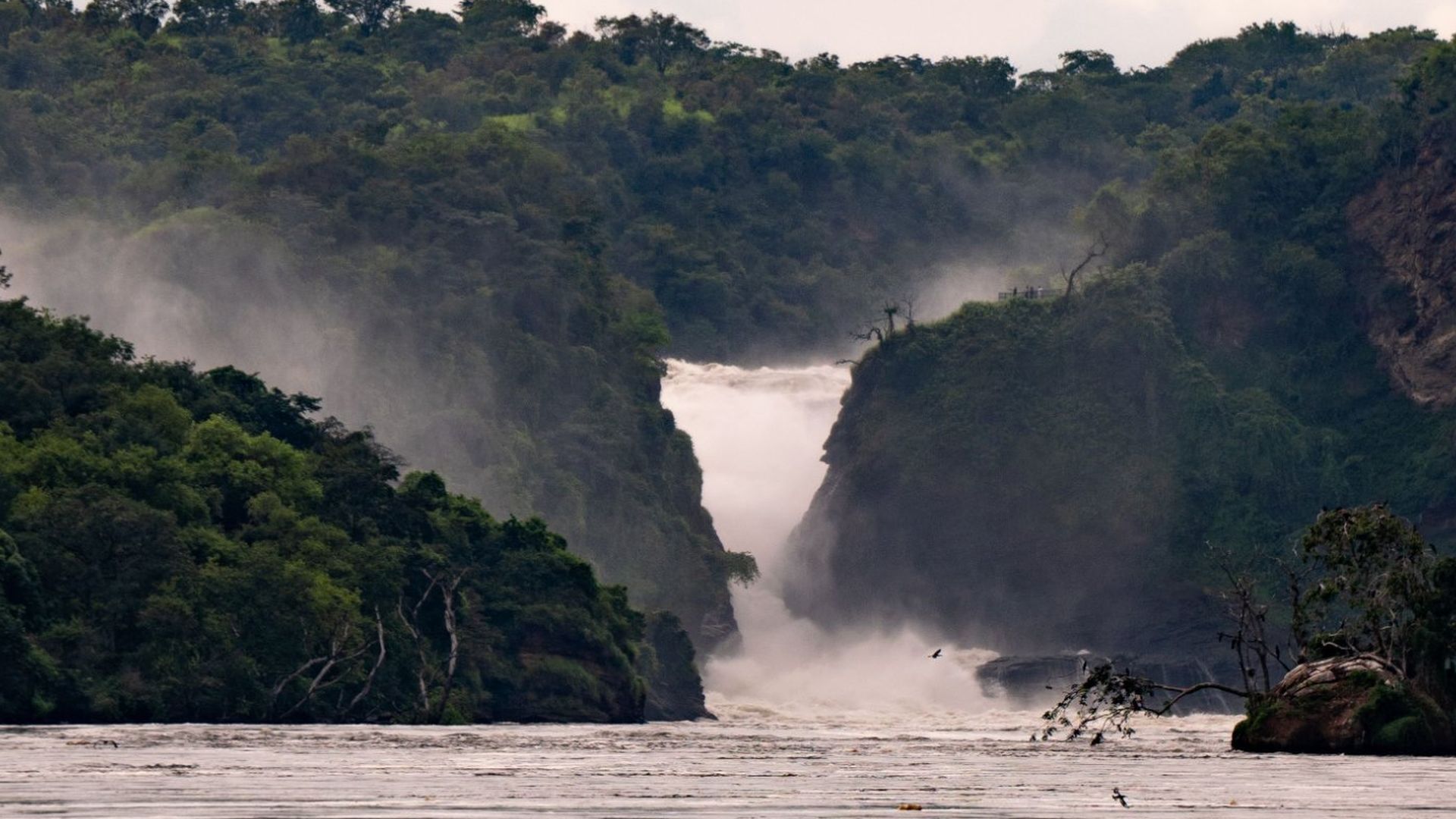
The Nile bursting through the narrow rock gorge at Murchison Falls, Uganda, between forested cliffs
Uganda — Deep dive

A whole river, through a seven-metre gap

Above the falls the Nile runs a hundred metres wide. Then the land closes in, and the main flow is forced through a crack in the rock about as wide as a two-lane road.

Back to Uganda

Many waterfalls are famous for their height. Murchison Falls is famous for its squeeze: the Nile, on its way from Lake Kyoga to Lake Albert, is funnelled into a gorge only about seven metres wide and drops some 43 metres in one violent rush. Standing at the top, you feel it through your feet before you see it.

The falls in numbers

The gap
About 7 mThe width of the rock opening the main channel is forced through.
The drop
About 43 mRoughly the height of a 14-storey building, in a single plunge.
The flow
About 300 m³/sAround 300 cubic metres of water every second, enough to fill an Olympic pool in under ten seconds.

Figures are commonly cited approximations; flow varies with the season and the level of the lakes upstream.

Video

Watch the Nile go through the gap

Video: “Murchison Falls: Africa’s Most Breathtaking Waterfall” by Corno van den Berg, watch on YouTube. The video loads from YouTube only when you press play.

Three stories behind the falls

The name

Named for a man who never saw it

Samuel Baker and Florence Baker, travelling up the Nile in 1864, were the first Europeans recorded to see the falls. Baker named them after Sir Roderick Murchison, president of the Royal Geographical Society in London, who never visited. In the 1970s, Idi Amin's government renamed them Kabalega Falls, after Omukama Kabalega, the king of Bunyoro who resisted British rule. That name was never made legally official, and Murchison returned after Amin fell, though you will still hear Kabalega used.

The second waterfall

Uhuru Falls, born with a nation

Just before the main gorge, the Nile splits. The larger branch forms Murchison Falls; a smaller one spills over a wider ledge nearby as Uhuru Falls. Local accounts say this second channel broke through around 1962, the year Uganda became independent, which is why it carries the Kiswahili word for freedom.

The decision

Kept wild instead of dammed

In 2019, Uganda's government rejected a proposal to build a hydropower project at the falls, choosing to protect one of the country's most important tourism sites. For a river already harnessed elsewhere in Uganda, it was a clear statement that this stretch would stay untamed.
A timeline

From explorers to film crews

1864

The Bakers arrive

Samuel and Florence Baker reach the falls and name them after Roderick Murchison.

1926

Protected land

The area around the falls is set aside as a game reserve, the start of today's national park.

1951

On film

The region appears in The African Queen, starring Humphrey Bogart and Katharine Hepburn.

1954

Hemingway's crash

Ernest Hemingway's sightseeing plane comes down near the falls; he survives, and a second crash follows the next day.

Seeing it for yourself

There are two classic ways to experience the falls, and most visitors try to do both.

From the river below

  • Boat trips run upstream along the Nile toward the foot of the falls, passing hippos, crocodiles and elephants at the water's edge.
  • The boats stop at a safe distance, where the view up into the gorge matches the photo at the top of this page.

From the top

  • A short walk at the top of the falls takes you to the edge of the gorge, where the noise, spray and force are overwhelming.
  • Some boat trips drop hikers near the base for a trail up to the top; ask your operator or the park in advance.

Plan the rest of your Uganda trip

Murchison Falls pairs naturally with gorilla trekking in Bwindi, chimpanzees in Kibale and game drives in Queen Elizabeth National Park.

Back to Uganda